Highlights from the 2026 Australian Native Bee Association Conference
August 25, 2026
Retirement and the art of plant propagation
September 10, 2026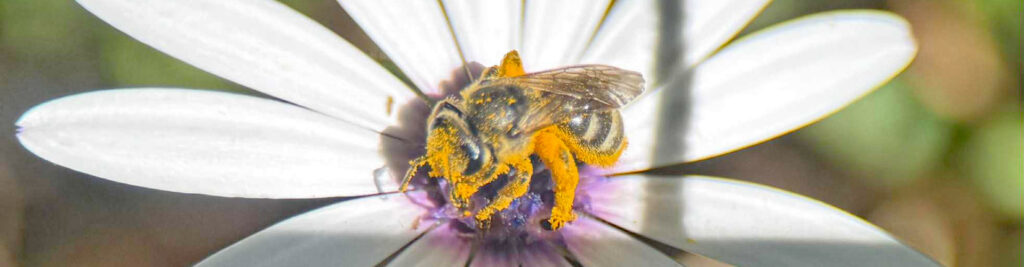
It’s pleasing to have seen the level of interest in our previous blog, on the varroa threat to honey bees. The arrival of this bee parasite in Australia, a couple of years ago now, has focused attention on the essential role of pollination for the country’s food crops. This article explores this topic in more detail, identifies additional threats to pollination, and highlights some of the ways in which we can respond.
Recognising the imminent threat of varroa, the honey bee industry identified early the need for a national pollination strategy. The Wheen Bee Foundation, a Sydney-based not-for-profit charity, was able to provide leadership and institutional support to publish the Pollination Security Status Report 2026, as a first step towards a projected national pollination strategy.
Prior to discussing the Pollination Status Report, though, let’s revisit the process of pollination. The exchange of genetic material between organisms is one of the foundational life processes, in which the pool of genetic variability is maintained and used by evolution to do its job in adapting all plant and animal species to their varied ways of life. For plants, pollen as the male sex cell or gamete is usually carried between individuals, and on its delivery to the female sex cell of the receiving plant fertilisation is achieved. A nourishing and protective capsule for the developing seed/s is then built, which we know better as a piece of fruit.
Wind pollination was the first way in which land-based plants effected the transfer of pollen: tiny pollen grains could be made in such high numbers that, despite the infinitesimal chances of any one grain finding its target, this method was, and remains, an effective way of reproduction, as conifers have demonstrated over hundreds of millions of years (and secondarily grasses, as flowering plants, more recently).
Then, around the time of the dinosaurs 150 million years ago someone started to cheat: a clever little plant got its pollen Uber-delivered to the front door. Suddenly plants, instead of having to devote their energies to producing buckets of pollen, could grow a visible drop-off point, while at the same time delivering their pollen by the same courier. This innovation marks the beginning of the explosion of flowering plant, or angiosperm, diversity that we see today.
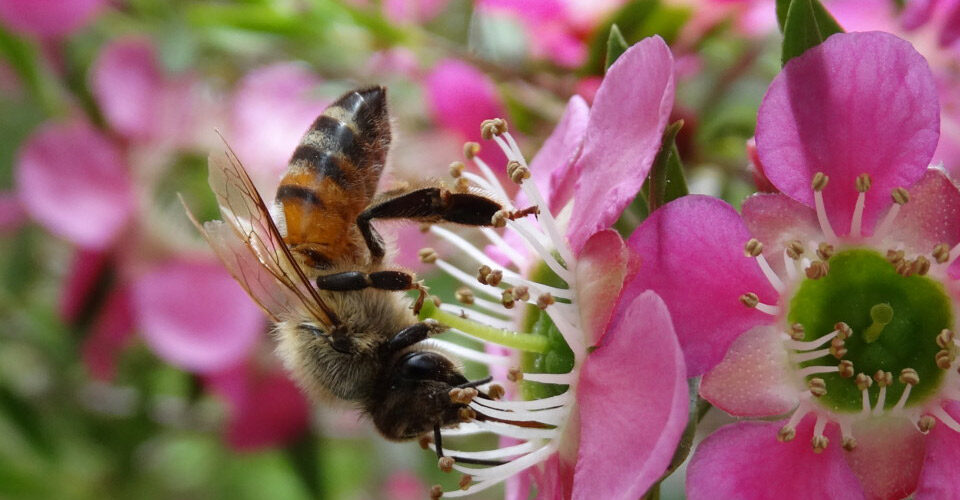
Complementing the drop-off point, of course, are the couriers, the insects and other animals (birds and mammals) that carry the pollen between plants. Naturally enough the couriers expected a delivery fee, which the plants provided as a sweet drink in the form of nectar. Beetles and butterflies got in on the act too, but amongst the insects it was flies and bees particularly who became the expert pollinators.
The expertise of the honey bee (Apis mellifera) has been elevated to the highest levels through some special adaptations. First, by living communally and regulating hive temperatures, bees in large numbers can forage earlier in the day than other insects.
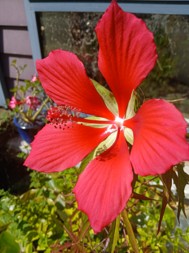
Hibiscus flower 'putting out the flags". Photo by Charlie Blumer.
Second, and particularly so in temperate climes, they can forage further and remain active for longer in the season by storing energy supplies for the future in the form of honey.
Third, and most remarkably, they show what is known as fidelity by returning to a good supply of nectar. In the darkness of the hive these foragers recruit their fellow foragers to this resource by telling them where and how far away these rewarding flowers are to be found.
As humans started domesticating their food crops these special qualities were taken advantage of (even if not well understood). For example, writing in the middle of the eighteenth century, the pioneering English naturalist Gilbert White observed
"If bees, who are much the best setters of cucumbers, do not happen to take kindly to the [cold] frames, the best way is to tempt them by a little honey put on the male and female bloom".
This honey bee-based pollinating service is today taken to extremes in the almond industry when, for two weeks of the spring-time flowering, thousands and thousands of bee hives are trucked into large monoculture orchards to fertilise the season’s crop (and are then taken away to recover).
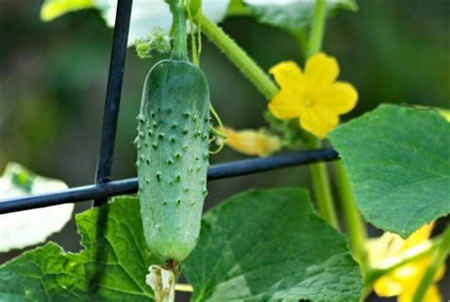
Cucumber plant waiting for the bees. Photo by Charlie Blumer.
From such a narrow perspective it is a short step to conclude, inaccurately though, that honey bees are the only significant pollinators in the world. This view is quickly refuted, though, by the simple observation of the range of insects that visit flowering crops. As each plant specie’s pollen is uniquely patterned (like finger-prints), close examination of the pollen grains found on many types of insects demonstrate their involement in pollination. A study of strawberry crops in Poland, for example, found that beetles, flies, and several species of native bees also contributed.
A more general picture has been identified by local researchers at the Australian National University (ANU), in their review of the global scientific literature on pollinators. They identified, beyond honey bees, suites of native pollinators that have evolved in association with the major food crop families, which humans have domesticated around the world.
On the Australian continent suites such as these have not yet had a chance to evolve: the food crops that are grown here since European settlement have nearly all been imported from other countries. One notable exception is the macadamia nut, and it turns out its smaller flowers that are too small for honey bees are best pollinated (and always have been) by native stingless bees.
Until now the over-reliance by Australian horticulturalists on feral (living in the bush) honey bees for the pollination of their crops has been under-recognised. The 2025 experience of Bilpin orchardists, when apple harvests were much reduced as varroa spread through the region, and reported in the Pollination Security Status Report exemplifies this over-reliance. North American research suggests 90% of feral honey bee colonies are lost on first exposure to the varroa mite, and some reports of crop losses in Bilpin were of similar magnitude.
There will thus be a predictable increase in demand, and competition, for commercial honey bee-based pollination services for horticulturalists in general, in response to possible future harvest losses. This, however, will have to be set against beekeepers exiting from the industry, due to depressed honey prices because of the major supermarkets favouring cheaper imported product.
Larger scale honey bee-based pollination services, though, are not the only solution: the Pollination Status report identifies the role that native bees, managed and un-managed, can play as part of a broader strategy. Again, research at the ANU has shown that native bees are as effective at pollinating blackberries as are honey bees, which has been endorsed by the Australian Department of Agriculture. The presentation of a number of research reports on native bee management and pollination at the 4th Australian Native Bee Conference demonstrates a growing interest and recognition of the pollination potential of Australia’s native bees.
The presence of diverse floral resources and habitat is essential for the broader survival and well-being of our native pollinators. The Pollination Status report identifies land clearing as one of their major threats, together with the use of herbicides/pesticides and the effects of climate change.
How do we as individuals respond?
The uptake of electric cars and solar panels at home is remarkable, and deserves celebration. Unfortunately we are less likely to influence our national governments’ protection and cosseting of the oil and gas industries. Where we have more power, with our hip pockets and food spend, is that we can choose to buy our food locally (‘food miles’ are a major source of carbon emissions) and directly from environment-friendly growers and farmers practising regenerative agriculture. The increasing popularity of farmers’ markets around Australia attest to this trend.
We can as well grow more food in our gardens, for ourselves and for the pollinators, and provide them with homes and habitat. A range of resources on bee friendly planting in support of this is to be found on our website.
And lastly we should very much buy only Australian-made honey, both to reduce importation of honey of questionable quality as well as to support our local beekeepers and their bees.
Dr Charlie Blumer
Retired epidemiologist with a first degree in insect life and ecology, ACT for Bees committee member and Vice President of the Canberra Region Beekeepers Association
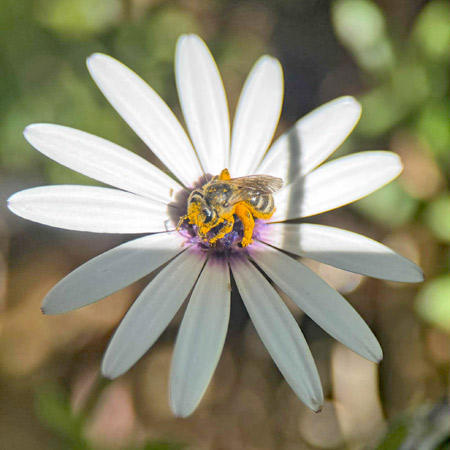
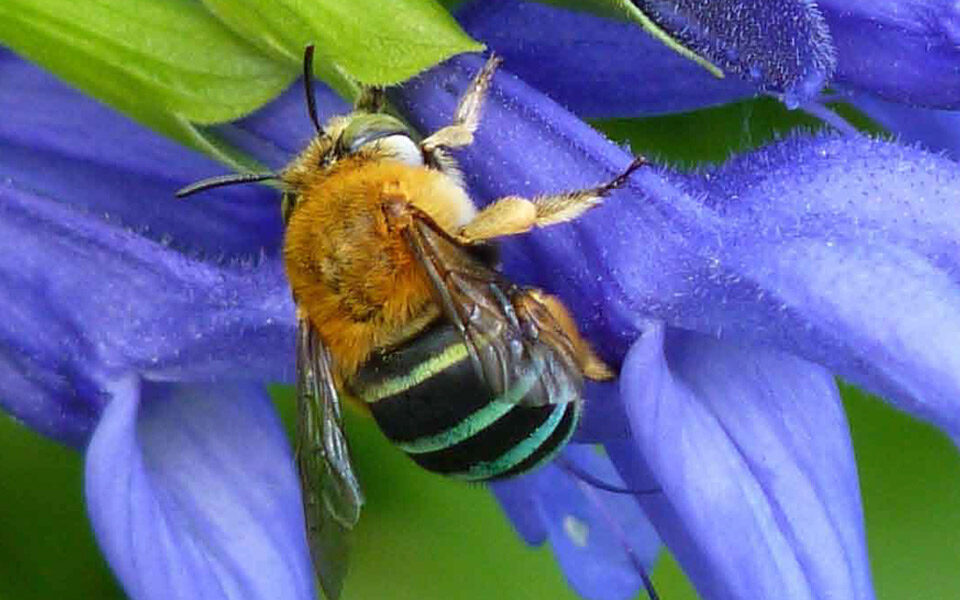
A native bee takes a pollen bath in Charlie's garden. Photo by Peter Abbott.
Sources
Gudowska A, Cwajna A, Marjańska E, Moroń D. (2024) Pollinators enhance the production of a superior strawberry – A global review and meta-analysis
Brown J, Cunningham SA. (2019) Global-scale drivers of crop visitor diversity and the historical development of agriculture
Seeley T. (2019) The Lives of Bees: The Untold Story of the Honey Bee in the Wild
ANU Fenner School. Rubus berry pollinator information sheet (PDF)
Li M, Malik A, University of Sydney Business School (2022) The footprint of food miles – we need to start counting