Grasping the nettles
August 19, 2026
In praise of… pollination!
September 2, 2026
There’s a lot going on in the native bee ecosystem recently, with researchers, students and educators, stingless beekeepers, local farmers, citizen scientists, indigenous knowledge bearers and policy advocates gathered for the 4th Australian Native Bee Association Conference in July 2026.
The beautiful Cairns Botanic Gardens provided the backdrop for the 2-day event, attended by 130 participants, all keen to hear the latest on native bees.
Peter Abbott, citizen scientist, ACT for Bees member, and author of Native Bees of the ACT: A Spotter’s Guide, welcomed the opportunity to escape the Canberra winter for the warmth of the tropical north.
Here is Peter’s report.
With so many attendees from diverse backgrounds, this was an intense event. Presentations covered a wide range of topics, with most kept short and sharp at 10 minutes each. Following two days of formal presentations, attendees spent the third day participating in field trips to either a property at Bartle Frere (south of Cairns) or a tour of the Cairns Botanic Gardens.
Of particular interest were the talks focusing on stingless social bees. Of the 12 known species, 7 live in the Cairns region. For those unfamiliar with stingless bees, they are small (3.5-5mm), mostly black, with a social structure similar to honeybees, which means they can be managed in small artificial hives. Their fascinating social behaviour has made them favourites among amateur beekeepers, researchers and native bee enthusiasts.
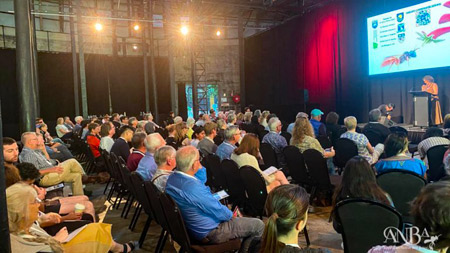
Native bee enthusiasts listen to a presentation at the 2026 Australian Native Bee Conference in Cairns, Queensland. Image source: Megan Halcroft.
Despite their popularity, there is still much to learn about stingless bees. Researchers are investigating everything from their social structures, nutritional needs and responses to pesticides through to the distribution of genetic variations across Australia. Other studies are exploring the significance of ‘sugarbag’ bees in Indigenous knowledge systems, differences in the pollination behaviour of male and female bees, and the antimicrobial properties of stingless bee honey and propolis. Even the microbiome of these tiny pollinators is attracting attention for its potential role in immune and digestive health.
The quantity of research addressing a breadth of questions is impressive and we are likely to see increased commercially driven management of stingless bee colonies in the future.
Alongside research into social stingless bees, scientists are making significant advances in understanding the diverse solitary bee species that support Australian ecosystems. The last decade has seen a huge increase in public awareness and interest in native bees, with postings on social media sites, plantings to restore habitat, and construction of bee hotels.
Research into solitary bees is equally diverse. Scientists are continuing to document species and map their distributions, while also investigating pollen preferences, nesting arrangements and social behaviours. Other projects are examining threats from pests, agricultural chemicals, urbanisation and climate change, with the aim of improving conservation outcomes for these important pollinators.
Several presentations highlighted the conservation challenges facing native bees. Among the most sobering was the possibility that the Metallic Green Carpenter Bee (Xylocopa (Lestis) aerata), one of Australia's most remarkable native bee species, may no longer survive on Kangaroo Island. Once the species' last refuge in South Australia, the island has experienced environmental pressures, while competition from honeybees may have contributed to this species’ decline. Fortunately, these bees can still be found along parts of the NSW coast.
Besides the important role that solitary native bees play in supporting Australian native ecosystems, contemporary research increasingly recognises their potential to support crop pollination. Early studies are examining the benefits of planting native bee-friendly vegetation alongside commercial agriculture.
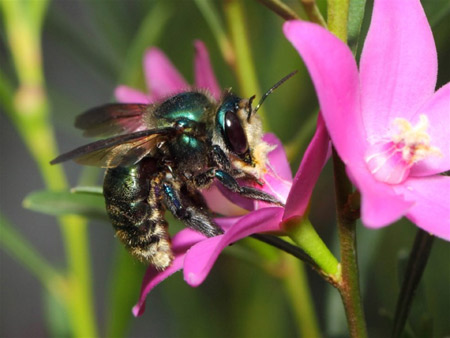
Metallic Green Carpenter Bee (Xylocopa (Lestis) aerata). Image source: Tim Leach, NatureMapr.
The role of native bees in pollination is also gaining traction in government policy and regulatory discussions. While their contribution is now better recognised in both natural and cropping ecosystems, it needs to be more fully reflected in the evolving Australian Pollination Strategy.
Additionally, native bee health should be considered in agricultural chemical risk assessments to help protect their pollination services in horticultural crops. These steps may improve native bee conservation at a time when both managed and wild honeybee populations continue to come under threat.
As public and commercial interest in native bees continues to grow, forums such as the Australian Native Bee Association conference play an important role in sharing current research and supporting native bee conservation efforts.
What can you do?
One of my strongest takeaways from the conference was just how much there is still to learn about Australia’s native bees. Whether you're a gardener, nature lover or citizen scientist, there are plenty of ways to get involved. You can help by creating pollinator-friendly habitat, contributing observations to NatureMapr, and learning more about pollinators.
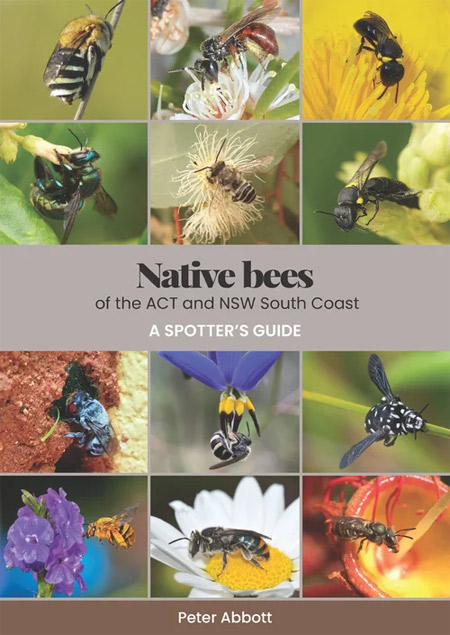
If you'd like to start identifying the native bees in your own backyard, my book, Native Bees of the ACT and NSW South Coast: A Spotter's Guide, provides an introduction to the remarkable diversity of species living right on our doorstep.
Peter Abbott
Citizen scientist, author and ACT for Bees member