
Connection Matters: How small actions create big change
August 10, 2026
Grasping the nettles
August 19, 2026
Imagine walking out your front door to find what looks like a football made entirely of bees hanging from your favourite tree.
Your first instinct might be to run.
Instead, take a closer look (from a safe distance). You may be witnessing one of the most fascinating events in the honey bee calendar: a swarm.
While it can look alarming, a swarm is not an emergency. In fact, it's a sign of a healthy colony doing exactly what honey bees have evolved to do for millions of years. And there is no threat—the bees are focused on keeping their queen warm and safe.
So, what is a swarm?
Unlike mammals, where individuals reproduce, honey bee colonies reproduce by splitting in two. As spring approaches, a strong colony begins raising new queens. When the time and weather is right, the old queen leaves the hive with anywhere from 30–70% of the worker bees.
Together, they temporarily settle on a nearby branch, fence or shrub while scout bees search for a suitable new home. Once enough scouts agree on the best location—a remarkable process of collective decision-making—the entire swarm takes off together to take up residence and establish a new colony.
Meanwhile, the original hive isn't abandoned. A new queen emerges, mates and starts laying eggs and focusing the efforts of the colony.
It's one colony now become two.
When is swarm season in the ACT?
In the Canberra region, honey bee swarms are commonly seen between August and December, with the peak usually occurring during late September/early October, depending on seasonal conditions. The exact timing changes from year to year.
A mild winter, early flowering plants and several weeks of warm weather can stimulate colonies to build up more quickly, potentially leading to earlier swarming. On the other hand, a cold snap or prolonged wet weather can slow colony development to delay the swarming season.
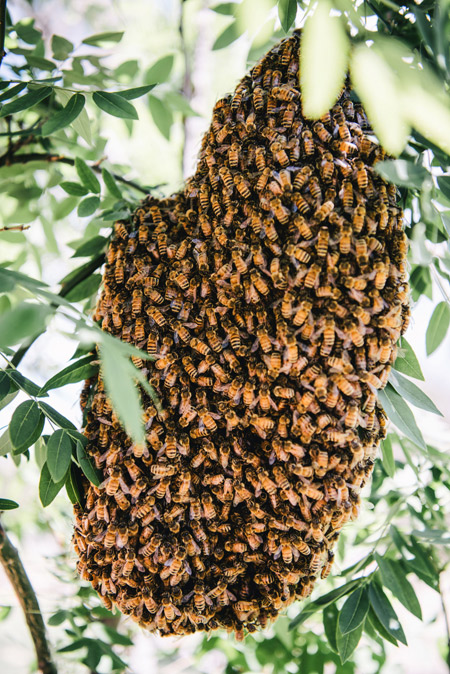
A honey bee swarm hanging in a tree, waiting for scout bees to locate a suitable new home.
This year, recent mild conditions have prompted some local beekeepers to wonder whether swarming might start early. That's certainly possible, and the continued production of brood through winter supports this view. Like the bees themselves, though, we'll have to wait and see what spring delivers.
Why do thousands of bees just sit in a tree?
Once the old queen and her retinue leaves the hive, the swarm usually flies only a short distance before stopping.
The bees form the familiar hanging cluster around their queen, while scout bees fan out in all directions looking for suitable nesting sites. Tree hollows are a natural preference, but wall cavities, chimneys, roof spaces, possum- and bird-boxes and sheds can also look appealing (we've seen a swarm take up residence in a cupboard storing fishing gear in a courtyard!).
A swarm may remain in one place for only a few hours, or for a couple of days if poor weather delays their departure.
The swarm is actually a highly organised temporary camp. Thousands of bees work together to regulate temperature, protect the queen and wait for the scouts to return with news of potential new homes.
Are swarms dangerous?
Surprisingly, they are not. A swarm is one of the calmest groups of honey bees you'll ever encounter.
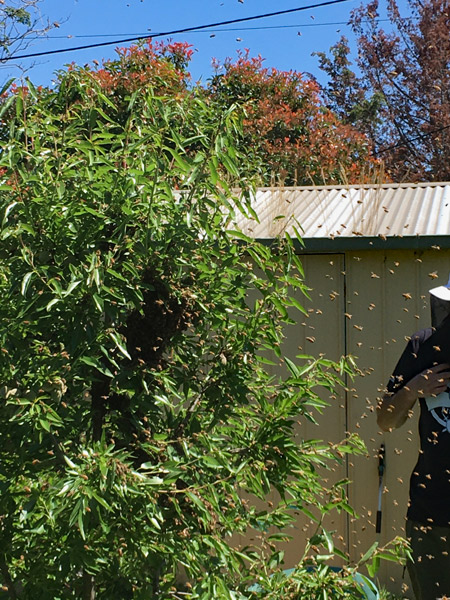
Honey bees swarming around and settling in a tree in a suburban backyard.
Unlike bees defending an established hive, swarming bees have no brood or honey stores to protect. Their priority is to find a new home, and not to defend any territory.
That doesn't mean they're harmless.
Bees can still sting if they're threatened, so it's important to:
- admire the swarm from a distance
- keep children and pets away
- never throw objects, spray water or attempt to disturb the cluster.
And of course, anyone with a known allergy to bee stings should keep well clear.
Swarm or established colony?
This is one of the most common questions people ask.
A swarm is usually:
- a dense cluster hanging in the open
- newly arrived
- temporary
- likely to leave within a day or two.
An established colony behaves very differently.
If you see bees repeatedly flying in and out of a hole in a wall, roof, chimney or tree hollow, they've probably already moved in. At that point they're no longer a swarm—they've established a permanent colony.
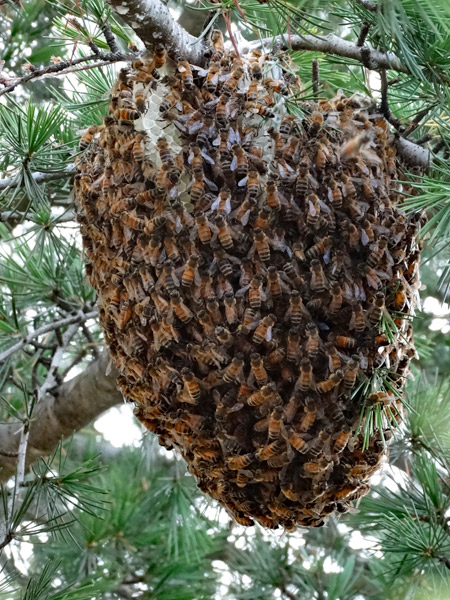
If a honey bee swarm cannot find a suitable cavity (like a hollow tree trunk), they occasionally build their combs in the open on a tree branch.
What should you do if you find a swarm?
Stay calm.
If the swarm isn't causing an immediate risk, the best approach is often to simply leave it alone. Many swarms move on naturally once the scout bees have found a suitable new home.
If the swarm is in a location where it could pose a risk—such as near a front door, school or busy public area—report it to Amateur Beekeepers Australia. A registered swarm collector can safely relocate the bees into a new hive home rather than destroy them. If possible, take a photo from a safe distance to include with your report. It can help confirm whether you've found a temporary swarm, or an established colony of bees, or other insects such as wasps which sometimes happens.
If bees have already moved into a wall cavity or roof space, report them promptly. Removing an established colony is usually much more difficult than collecting a temporary swarm.
Please don't spray swarms with insecticide. Honey bees are important pollinators, and most swarms should be safely relocated rather than destroyed.
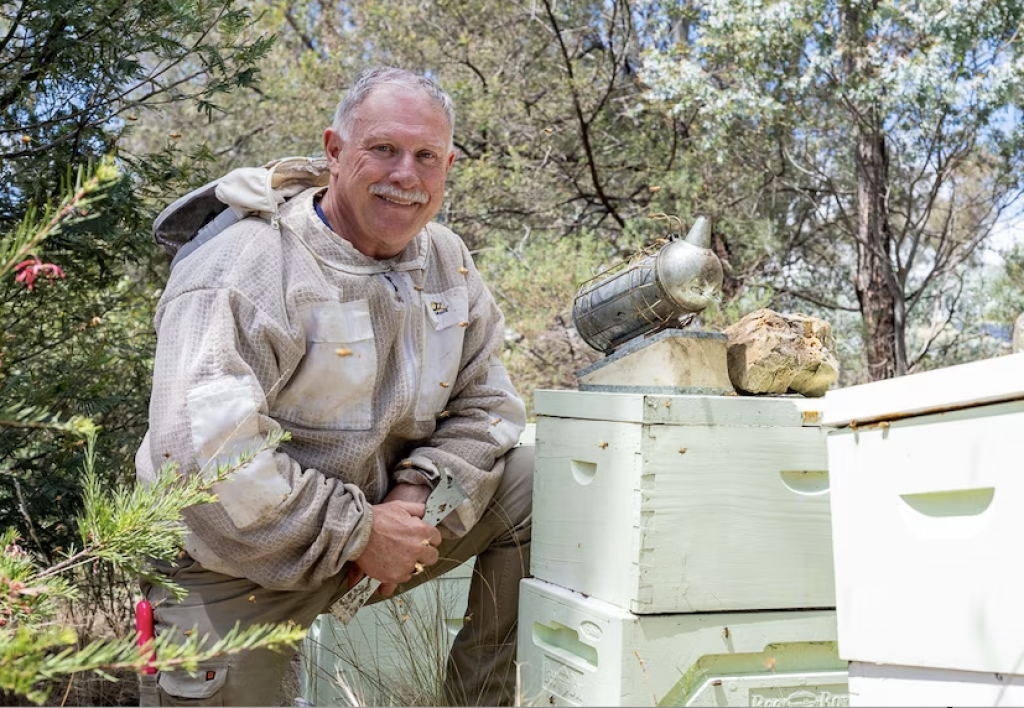
What about beekeepers?
For beekeepers, swarming is both exciting and frustrating.
A swarm represents the natural reproductive success of a colony—but it also means losing a significant proportion of the originating hive’s workforce just as the main nectar flow begins.
Beekeepers practising good colony management aim to reduce unnecessary swarming through regular inspections, providing sufficient space, replacing ageing queens and putting up bait hives to attract the attention of those scout bees. Even then, experienced beekeepers know that some seasons simply produce more swarms than others.
One of nature's greatest spectacles
Each spring, some Canberrans will encounter their first honey bee swarm.
For some, it's a frightening experience. For beekeepers, it's an exciting phone call. For the bees, it's simply the next chapter in the life of a vigorous and healthy colony.
So if you happen to discover what looks like a buzzing football hanging from a tree this spring, take a moment to appreciate what you're seeing. You're watching a superorganism reproduce—one of the most extraordinary natural events happening in our own backyards.
Help more people understand bee swarms
One of the biggest threats to swarms isn't the bees themselves—it's a human misunderstanding of their purpose and nature.
If this article has changed the way you think about swarms, please share it with your family, friends or local community groups. The more people know what a swarm is and how to respond, the more likely these remarkable pollinators are to be safely relocated rather than unnecessarily destroyed.