
Extraordinary flowering, native bees, hands-on workshops — and why pollinators need us more than ever
February 8, 2026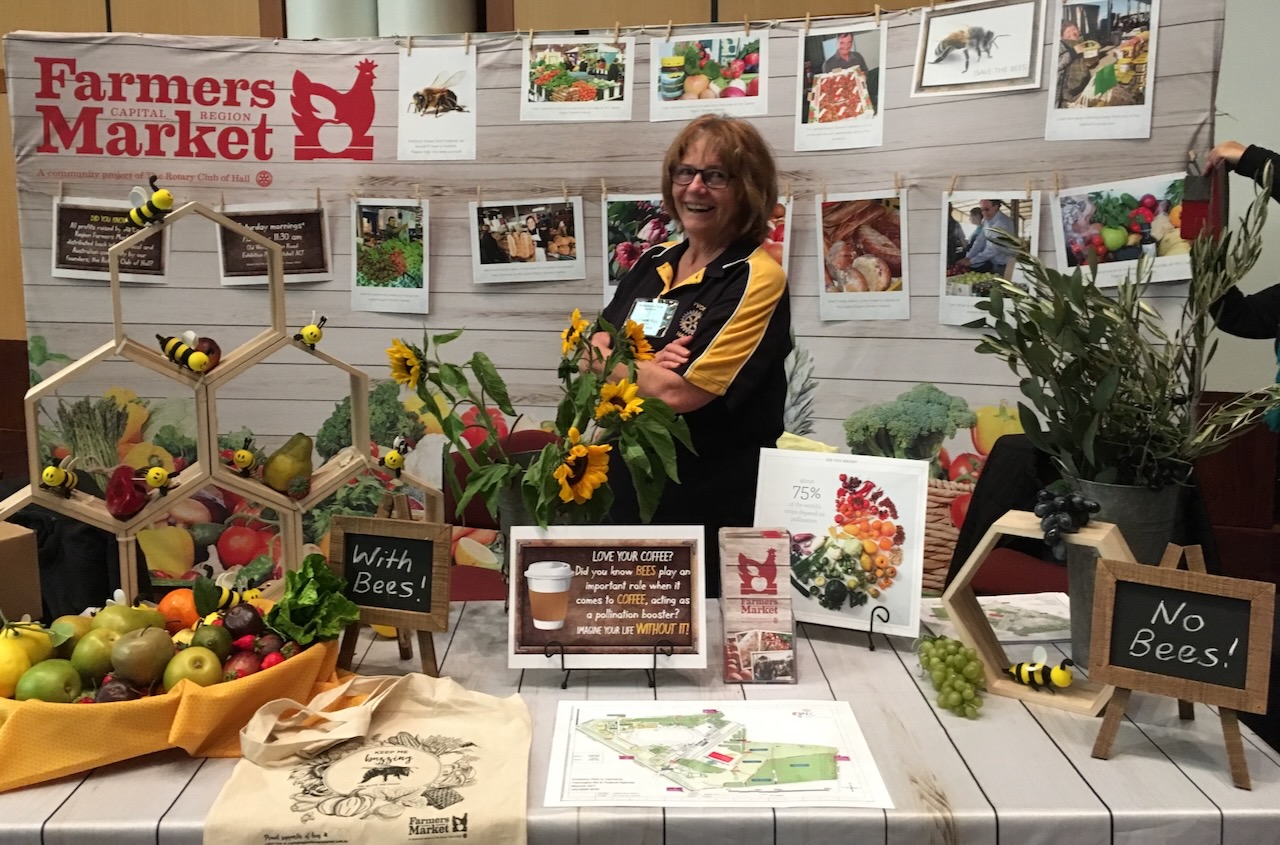
World Bee Day celebrations
May 12, 2026Autumn has arrived with abundance. Thanks to some steady rainfall, followed by a run of sunny weather, we’ve seen exceptional flowering across the region, bringing a vibrant return of pollinators to our gardens and streets.
Blue-banded bees, leaf-cutter bees, honeybees and Eastern spinebills have been visiting Salvias, while masked bees and wasp-mimic bees gather in blooms of the bottle brush. Plantings of Wahlenbergia on the verges have also been alive with native bee activity.
It is still possible to plant while the soil is still warm, but very soon it will be too cold for new plant roots to settle in.
Read more:
We’re very much looking forward to the World Bee Day celebrations at the Capital Region Farmers Market on 16th May, ACT for Bees + members will be present with their stall and will love to say hello. Local radio station ABC 666 will also be broadcasting live from the market with bee-related stories and guests. Come and make a few seed bombs for your garden or enjoy watching the children play ‘Being a bee and pollinating the apple trees’ as well as other children’s activities.
More information on related events is provided on the World Bee Day Australia website where you can find the events happening in your region.

Building Resilience in ACT Pollinators
We were very pleased to take part in the ACT Government’s Building Resilience in ACT Pollinators workshop, bringing together 80 ParkCare volunteers and Rangers with leading researchers including Prof. Saul Cunningham (ANU Fenner School) on supporting bees in parklands, Prof. Sasha Mikheyev (ANU) spoke on bee genetics, disease dynamics, and resilience, Suzi Bond (ANU Fenner School) on Canberra’s butterflies and moths, Clare Wynter (ACT Wildlife) on flying foxes and Julie Armstrong (ACT for Bees +) shared planting resources including the ACT Government’s Urban Planting calendar. with leading researchers.
Key insights from the workshop included:
- The importance of plant diversity, especially ancient Australian plant families
- The deep evolutionary relationships between native bees and flora
- Emerging research on bee genetics, disease, and resilience
- The importance of habitat protection for butterflies, moths, and flying foxes
Hands-on Learning & Habitat Creation workshops included
- Native bee presentations and bee hotel construction
- Creating habitat in parks using drilled dead wood
- Pollinator demonstration gardens
- Educational honeybee hive displays
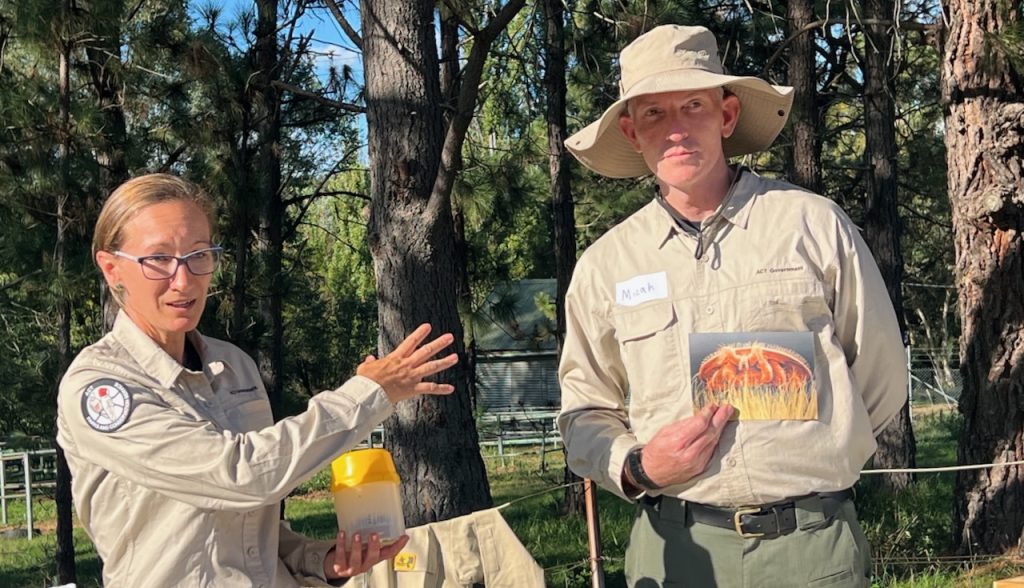
ACT Government Bee Biosecurity officers Jemma and Micah explaining about Varroa mites in Honeybee hives
Community Highlight
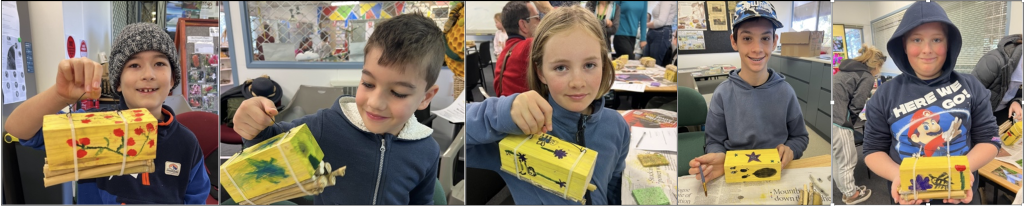
Happy Junior Rangers with their bee hotels!
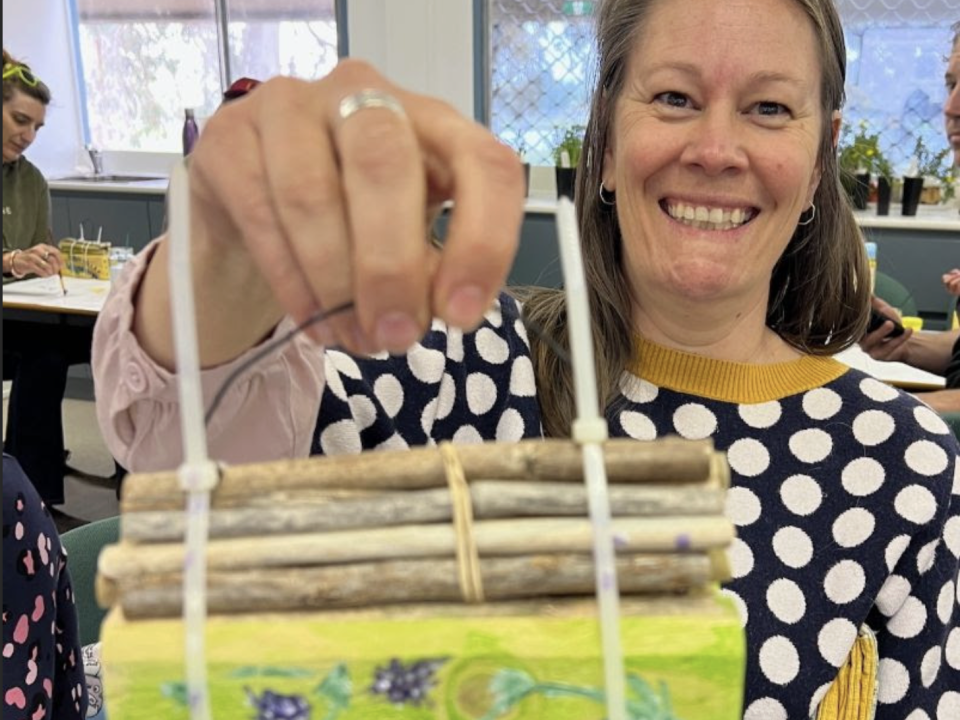
Thanks to an ACT Government’s 2025 Environment Grant, our 4th Valentine’s Day Bee Hotel workshop—“Send a love message to our native bees”—was a joyful collaboration with the Ginninderra Catchment Group.
With thanks to the Group’s convenor Anke Maria Hoefer:
- An enjoyable morning was spent learning about native bees
- 20 bee hotels were created
- 4 new members joined ACT for Bees
A beautiful example of community action for pollinators.
For our 5th bee hotel workshop, we’ve just spent an exciting Sunday morning at Canberra City Farm with 25 Junior Rangers (and parents). Ranger Miriam and members of the Molonglo Conservation Group supported the creation of some beautiful nesting spots for native bees when the weather warms up! A wonderful group of children aged 7-14 who were so engaged.
Celebrating 10 Years of Love Food? Love Bees! curriculum

We’re proud to celebrate a decade of collaboration with Cool.org:

- 23 curriculum lessons
- 1.1 million young people reached
- 113,000+ students engaged in the past year
These free, Australian-aligned resources are helping the next generation understand the vital role of pollinators in food systems and biodiversity. Explore the resources

EVENTS
Why World Bee Day matters:
Celebrating Pollinators at the Capital Region Farmers Market
Every year on 20 May- the world acknowledges one of nature’s most important creatures: the honeybee. World Bee Day was established to raise awareness of the vital role bees and other pollinators play in keeping our ecosystems and food systems healthy. The people of Slovenia were instrumental in this because of the special place that honey bees have in the country’s history and culture. For us in Australia, It is a day to reflect, to educate, and to act on behalf of honey bees and other bees.
Bees are responsible for pollinating around a third of the world’s food supply, and approximately 80% of all flowering plant species. Without them, many of the fruits, vegetables, nuts and seeds we take for granted would simply disappear from our plates. Almonds are almost entirely dependent on bee pollination. So too are apples, cherries, blueberries, avocados and countless other foods. When bee populations decline, so does the quality, diversity and abundance of what we eat.
Healthy pollinator populations are also directly linked to food quality. Well-pollinated crops produce larger, more uniform fruit with better flavour, longer shelf life and higher nutritional value. For farmers and producers- bees are the foundation to production.
World Bee Day holds special meaning at the Capital Region Farmers Market. Our producers, from orchardists and almond growers to market gardeners, rely on healthy pollinator populations to bring quality food to your Saturday basket. Celebrating World Bee Day is our way of honouring that connection between nature, growers and community.So join us on Saturday 16th May 2026 as we celebrate World Bee Day amongst the very produce that relies on our amazing bees. The market will be hosting ABC Canberra Radio for a live broadcast, as well as traditional Slovenian Honey Breakfast (incorporating bread, apples and honey from our local producers). There’ll also be growers on hand to answer questions about the best bee-friendly plants for your garden, honey producers and exclusive honey themed food.
Saturday 16th May 7-11.30am
Capital Region Farmers Market
Exhibition Park in Canberra
UPCOMING EVENTS
World Bee Day celebrations
Saturday 16 May | 7am–11.30am
Capital Region Farmers Market (EPIC)
At Exhibition Park in Canberra
Saturday 16 May | 7am–11.30am
This year’s theme—“Bee Together for People and the Planet”—celebrates the partnership between people and pollinators in sustaining our food and eco-systems.
Please come and say hello to us at the ACT for Bees stall at the World Bee Day celebration at the Capital Region Farmers Market at EPIC on Saturday May 16th. ABC radio will be broadcasting live from the market buzz.and ecosystems.
Saturday 23 May | 11am–12pm
World Bee Day Hive Tour
Australian Parliament House
Join volunteer beekeepers for an insider’s look at the Parliament House bee hives and the role bees play in supporting the landscape of Capital Hill. Book here
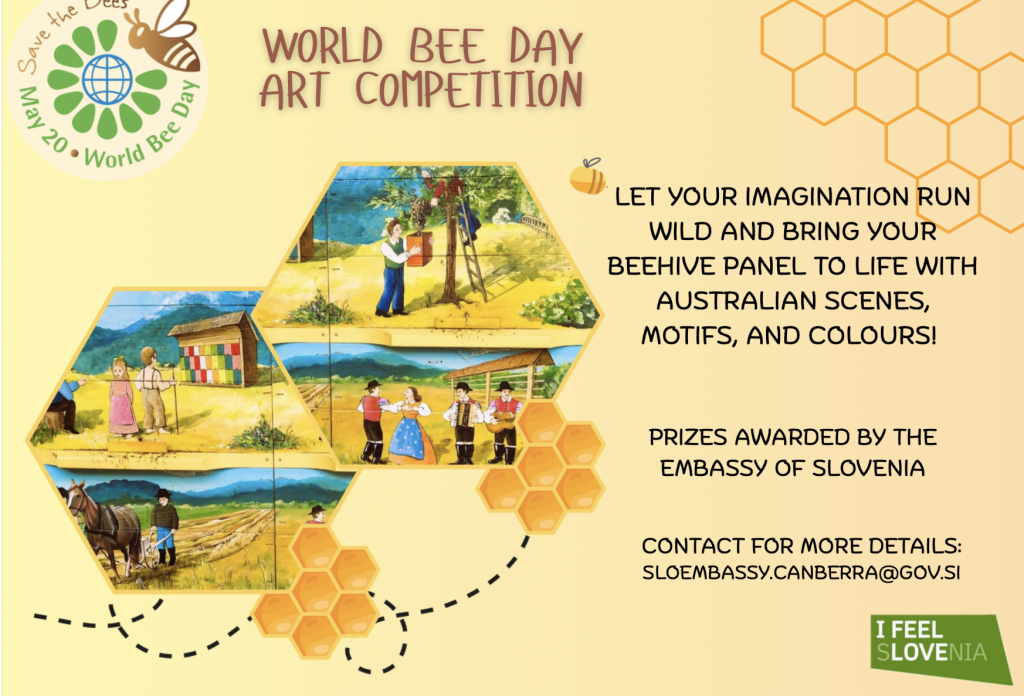
Schools, please join the World Bee Day Art Competition
In Slovenia, there is a tradition of decorating the front entrances of honey bee hives with wooden panels with colourful and imaginative scenes. These paintings are not only beautiful – they also help bees find their way home! Painted beehive panels are a unique part of Slovenian beekeeping and a special form of folk art. Traditional beehives show scenes from everyday life and religious/historical motifs from Slovenia. With this art competition, we’d love to see scenes and motifs from the Australian landscape that you would decorate a bee hive with. Let your imagination run wild and bring your beehive panel to life with Australian animals, landscapes, and colours!
Instructions: 1. Get a piece of thick paper that is 40cm long x 20cm wide 2. Create your design. Let your imagination run wild! Coloured pencils or textas are fine. 3. Complete the form and hand back to your teacher together with your artwork.
Name: ________________________________________________________
Year/class: ____________________________________________________
School: ________________________________________________________
Tell us about your design (optional): _________________________________________________________________
Canberra City Farm events
A Big Hot Heap
Sunday May 3rd 9.30am -2.30pm
How do we turn the Farm’s green waste into microbial gold? Please join us for this free, practical and hands-on workshop on how to make hot compost using our mini-Indore method. It’s a pretty simple recipe that allows us to:
- process all our end-of-growing-season organic matter (plus weeds)
- join the circular economy and
- regenerate our soil.
Voted #1 by all the fruit and veg plants at the Farm!
Plus we’ll also be demonstrating microbiological brewing and making biochar.Check out the Canberra City Farm website for more information and to register HERE
Canberra Environment Centre workshops
Community Garden Session Thursdays 9.30am-11am
We are getting our hands dirty to create a biodiverse garden in Harrison to support feeding the local community, pollinators and to keep our spirits high!Fun ways to learn skills in gardening, composting and recycling
Check out the Canberra Environment Centre’s website HERE
Interesting Links
Preserved orchids show pollination has fallen 60% since the 1970s
| A concerning article published in The Conversation reports on pollination trends in Australia since the 1970’s. From the outside- ecosystems can look healthy, but really species reproduction rates are quietly collapsing, due to declines in the number of bees and other pollinators. That’s in part what makes failures in pollination so dangerous – they are very hard to detect. Orchids, though, have a very specialised biology which allows them to act as early indicators of pollination decline. They are now telling us, as we have recently reported in the scientific journal Global Change Biology, that pollination is under increasing pressure. And that it has been for a long time. This threatens everything from global biodiversity to ecosystem resilience and food production. Read mor |
A few interesting books……

Evergreen: The Botanical Life of a Plant Punk
by Tim Enwisle
In this wildly rich memoir, a director at some of the world’s finest botanic gardens – Sydney, Kew and Melbourne – suggests such places are a cure for the world’s ills. Tim Entwisle believes these sanctuaries can address the key threats of our time, such as climate change and plant extinction, while simultaneously serving up gorgeous landscapes and offering a balm to the weary human spirit. Evergreen reveals the noisy soundtrack to Tim Entwisle’s life, why he prefers nature found kerbside rather than in the wild, and how he comes to have an alga (seaweed) named after him. Above all, it’s an ode to the powerful mix of nature, science and culture.
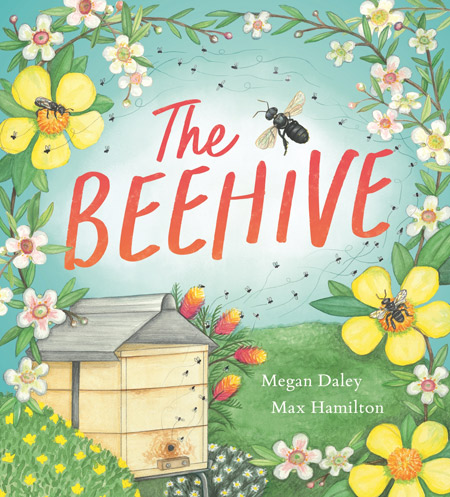
The Beehive
by Megan Daley
An Australian native bee focus for World Bee Day. Megan has stacks of teaching ideas to go with her book as well as a list of other bee books for children. Learn more
Hive day is finally here! Willow’s been counting down the days until groundskeeper Tom divides the school’s native stingless beehive into two, allowing her to take home her very own hive. Every detail must be perfect to ensure the bees flourish in their new home. The story unfolds beautifully alongside a treasure trove of captivating facts about Australia’s native bees, making ‘The Beehive’ a delightful and informative read.”
Together, we can create thriving habitats for pollinators—one garden, one verge, one community at a time.
Please come and say hello at the World Bee Day celebration at the Capital Region Farmers Market at EPIC on Saturday May 16th. ABC radio will be broadcasting live from the market buzz.
Keep a look out for Varroa Mites, Bees, and Our Future: A Time for Action and Optimism in our next newsletter.